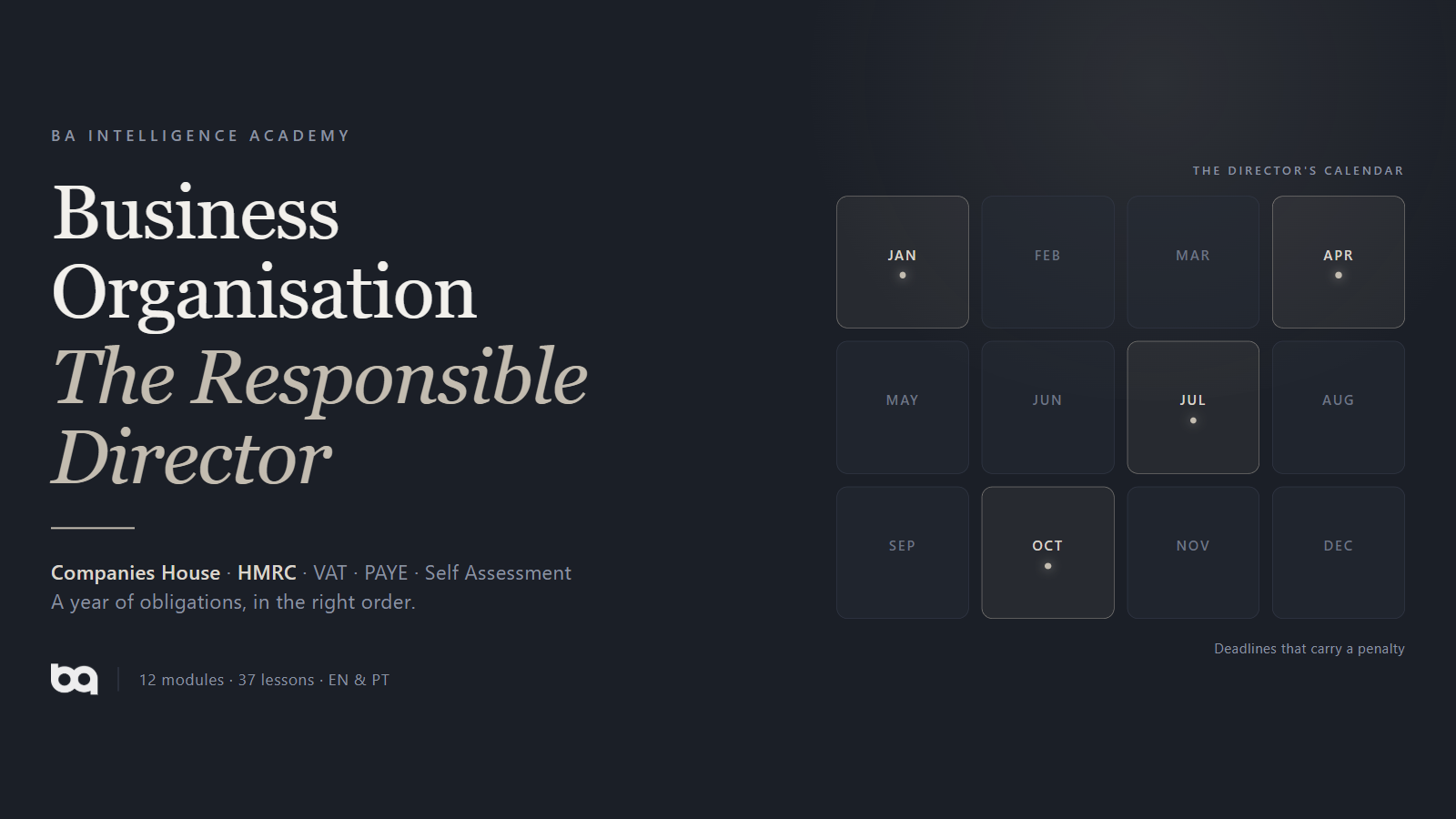
Business Organisation — The Responsible Director
A practical guide for anyone who runs — or is about to open — a company in the UK, built on a simple truth that almost nobody takes seriously: the company's tax and administrative health is the director's responsibility alone, not the accountant's. Your accountant knows the law and applies it, but works with whatever you hand over: the better organised it is, the better the work and the smaller the risk of an error or a penalty. You will learn the two ways of trading in the UK — Self Employed (Sole Trader) and Limited Company, with more weight on the Ltd because it is the more demanding structure — and, above all, how to stay in order with HMRC and Companies House throughout the year. It came out of the difficulty the author had running that side of his own business, which is why this is not an accountancy course. The goal is not to turn you into an accountant, but into an organised director: someone who compiles the information month by month instead of leaving everything to the last minute, who knows where and how to check each obligation at the official source, and who reaches the accountant with everything in order and on time. The same rules that punish whoever neglects them can work in your favour once you understand them — and that is exactly what this material teaches you to do.
What you'll learn
- Which model applies to you — Sole Trader or Limited Company — and when it is time to move
- How to open a Limited Company step by step, from the name to the Certificate of Incorporation
- The director's full calendar: what Companies House wants, what HMRC wants, and when
- How to change the company name properly: the resolution, forms NM01/NM04/NM06 and what to update afterwards
- A monthly financial routine: separate accounts, Director's Loan, salary versus dividends, receipts
- How VAT actually works — input and output VAT — and what changes for your prices
- PAYE and payroll in practice, including what changes when you hire someone
- Self Assessment as a director: the UK tax year, the deadlines and Payment on Account
- How to close the company properly — dormant, DS01, and what HMRC still expects from you
- Tax residency and income from Brazil, and how to recognise a real government contact
Full access · Lifetime
- 12 modules
- 2 free intro lessons
- Lifetime
- EN + PT Bilingual
Course Curriculum
Module 1
Introduction
Why This Course Exists — The 3 Most Common Director Mistakes
Understand the purpose of this course and the 3 mistakes that cost most directors money.
What You Will Learn — 10 Chapters + the Course Spreadsheet
A complete map of all 10 chapters and the support spreadsheet that accompanies the course.
Module 2
Chapter 1 — Sole Trader / Self-Employed
You ARE the Business — Key Differences from Ltd
The fundamental difference between Sole Trader and Limited Company, and how money flows in each model.
How to Register as Self-Employed + Ongoing Obligations
Step-by-step registration, UTR by post, and ongoing obligations: Self Assessment, National Insurance, VAT threshold.
Unlimited Liability and When to Consider Moving to Ltd
What unlimited liability means in practice and the signals that it may be time to open a Limited Company.
Module 3
Chapter 2 — Opening a Limited Company
Steps 1–4: Name, Roles, Address, SIC Code
Check the name at Companies House, define director/shareholder/PSC roles, choose the registered office address, and pick the SIC code for your business activity.
Step 5 — Identity Verification and Personal Code
How to generate your 11-character Personal Code via the GOV.UK ID Check app — the identity verification step required for all directors.
Step 6 — Submission, Certificate of Incorporation, and HMRC Link
Submit online, receive the Certificate of Incorporation and CRN, and understand how Companies House automatically notifies HMRC — and what the CT41G letter is.
Company Identity — All Your Credentials in One Place
Complete your Company Identity (Annex 1) with all 7 essential credentials: CRN, company UTR, personal UTR, GOV.UK One Login, Government Gateway ID, Authentication Code, and Personal Code.
Module 4
Chapter 3 — Director's Calendar
Companies House vs HMRC — Two Bodies, Two Calendars
The legal difference between Companies House (public register) and HMRC (taxes), and why the director is always the legally responsible party — not the accountant.
Your Company's Public Page + Setting Up Email Reminders
How to use your Companies House public page, set up WebFiling email reminders, and configure HMRC Government Gateway alerts.
How to Change the Company Name
Members' resolution, forms NM01, NM04 and NM06, the filing deadline, the new certificate, the CRN that never changes, and what to update afterwards — including VAT484 and HMRC.
Confirmation Statement + Mandatory Identity Verification (Nov 2025)
How to submit the Confirmation Statement, the new mandatory identity verification for all existing directors and PSCs since November 2025, and a real case of a near-closure.
Annual Accounts, CT600, VAT, PAYE and Self Assessment — Full Calendar
The complete director's compliance calendar: every obligation, deadline, and the one rule that can never be broken — always confirm on official sources, never from memory.
Module 5
Chapter 4 — Monthly Financial Organisation
Separating Accounts + Director's Loan Account
Why the company account must be completely separate, how the Director's Loan Account works, and the consequences of moving money outside formal channels.
Salary vs Dividends — Tax Implications and How to Record
The tax difference between salary (PAYE) and dividends, why most directors use a combination, and the essential habit of recording every informal movement immediately.
Receipts, Expense Categories, and MTD
How to organise receipts, basic expense categories, tools that help (spreadsheets, apps, MTD software), and why Making Tax Digital makes monthly organisation a necessity, not just best practice.
Module 6
Chapter 5 — VAT
What VAT Is and the Mandatory Registration Threshold
VAT (Value Added Tax): what it means in practice for a director, the mandatory registration threshold over any rolling 12-month period, and why the Monthly Revenue spreadsheet is your most important monitoring tool.
Voluntary Registration and What Changes After
When and why to register voluntarily, what practically changes on invoices and prices, and simplified schemes (Flat Rate) that may be more efficient for your business.
MTD for VAT — Real Case: The VAT Nobody Saw Coming
Making Tax Digital requirements for VAT-registered businesses, and the real story of a cleaning company that paid VAT out of their own pocket because nobody monitored the threshold monthly.
Module 7
Chapter 6 — PAYE and Payroll
What PAYE Is and How to Register as Employer
PAYE (Pay As You Earn) — how it works even for single-director companies, and how to register as employer before the first salary payment.
Payroll Cycle, FPS Submissions and Director's Responsibilities
The payroll cycle (FPS, net payment, HMRC remittance), the director's responsibilities, and Employer's NI as an additional company cost.
When the Company Has Employees Besides the Director
Right to work checks, pension auto-enrolment, and the individual deductions and benefits that come with hiring.
Module 8
Chapter 7 — Self Assessment
What Self Assessment Is and Who Needs to File
Annual personal income declaration — not only for Ltd directors. Who needs to file as a director and why not all directors are automatically required.
UK Tax Year, Deadlines, Payment on Account, and Dividends
UK tax year (6 April to 5 April), key deadlines, Payment on Account surprise, MTD ITSA, and why dividend documentation from Chapter 4 is essential for filing accurately.
Module 9
Chapter 8 — Closing the Company Properly
Pause or Close for Good — the Dormant Company
Dormant means different things to Companies House and to HMRC. How to pause the company, what breaks dormancy, and how to bring it back.
The Two Closing Routes and Strike Off Eligibility
Voluntary strike off versus formal liquidation, the eligibility tests, and why a dishonest DS01 application is a criminal offence.
What to Settle Before Dissolving
HMRC does not find out from Companies House. Closing PAYE and VAT, the final CT600, creditors, bona vacantia, the bank account order, and keeping records.
The DS01 Step by Step, up to Dissolution
Signatures, the fee, notifying interested parties within 7 days, the Gazette notice, the 2-month objection window, and restoring a dissolved company.
Module 10
Chapter 9 — Tax Residence and Income from Abroad
Statutory Residence Test — Worldwide Income Declaration
Tax residence is not the same as immigration status. HMRC uses the Statutory Residence Test — and if you are a UK tax resident, you must generally declare worldwide income, wherever it comes from.
What Catches People Off Guard + Worldwide Disclosure
The 3 common surprises: income still arriving from your home country, never formalising your departure from it, and the status of the double taxation agreement — worked through the Brazil case. Worldwide Disclosure penalties, and why declaring first reduces them.
When to Seek an International Tax Specialist
Taxation involving two countries requires a specialist. The 5 situations that demand expert advice — and the Brazil-UK specialists consulted in preparing this chapter.
Module 11
Chapter 10 — Security Against Scams
HMRC Scams — The Golden Rule and Common Patterns
The most important rule: HMRC never requests passwords, bank details or payment information by email, phone or text. The 3 most common HMRC scam patterns.
Companies House Scams — Especially After Opening
Letters charging for 'Enhanced Web Filing Access' or a 'legal publication fee' — none are real. Companies House only charges for registration and the annual Confirmation Statement.
Warning Signs and What to Do
The 4 warning signs of any suspicious communication, what to do when in doubt, and where to forward suspicious HMRC and Companies House messages.
Module 12
Glossary and Course Resources
Complete Glossary — All Key Terms and Acronyms
37 key terms from Annual Accounts to Worldwide Disclosure — everything you need to navigate UK business and tax confidently.
Download: Course Spreadsheet
Download the course spreadsheet — in English or in Portuguese — with all 4 tabs: Company Identity, Monthly Revenue, Expense Control and Director Movements.
What comes with it
- The companion spreadsheet, with the Company Details, Monthly Turnover, Expense Tracker and Director's Transactions tabs — Monthly Turnover warns you on its own as you approach the VAT threshold
- The course glossary, so you can look up any British acronym without leaving the lesson
- A quiz at the end of every chapter, so you can check the deadlines and procedures have stuck
- Screenshots of the official gov.uk and Companies House pages, showing where everything sits
- Certificate of completion
How access works
- One-off payment: you buy once and the content stays in your account
- The two introductory lessons are open, with nothing to pay — read them before you decide
- HMRC and Companies House rules change; when the material is revised, the revision reaches you at no extra cost
- Access is personal and works on one device at a time

Who wrote this
Patricia
Business graduate, specialised in Finance
Patricia learned this the hard way, alongside her husband's companies here in the UK: the rules are not only there to catch you out — understood in time, they work in your favour, and they save you money. What changed everything was not memorising a deadline, it was understanding the principle behind it. That is what this guide sets out to pass on to anyone running a company in the United Kingdom.
She is not an accountant, and this course does not replace one — which is exactly why every chapter shows you where to check the rule at the official source on gov.uk, rather than asking you to take her word for it.
This material is educational and informative, based on the HMRC and Companies House rules in force on the date of publication. It does not replace advice from a qualified accountant or adviser. Deadlines, thresholds and procedures are revised by the UK government — always confirm at the official source on gov.uk.
Ready to get full access?
The account is free and gives you the 2 introductory lessons straight away. The full course — 12 modules, 37 lessons — is £97, paid once.